Could an Outdoor Socket Box Make Your Home Safer and More Durable
As outdoor living spaces become more active and homeowners add lighting, landscape features and exterior outlets, the choice of enclosure for exterior wiring has taken on renewed importance. An Outdoor Socket Box is more than a tidy container for a receptacle; it acts as a good line of defense against weather, wear and accidental contact. Contractors, inspectors and property owners increasingly treat the box decision as part of a site’s safety and maintenance plan rather than a last-minute purchase.
An exterior enclosure protects electrical terminations from moisture, insects, UV exposure and mechanical damage. When an enclosure is suited to its environment, it reduces the chance of corrosion, loose connections and short circuits that can good to outages or safety hazards.
Seen this way, selecting an Outdoor Socket Box is a preventative step that supports reliable performance and easier upkeep in the long run.
Two common construction approaches—metal and non-metallic materials—each bring advantages depending on site exposure and installation methods.
Considering the installation environment and how the box will be mounted helps teams avoid corrosion, loosening fasteners or improper grounding paths later on.
Beyond the box material, the chosen cover, gasket and sealing approach determine how well the assembly performs in service. Weather-resistant covers and in-use shields let cords remain connected while still protecting internal connections from rain and spray.
A thoughtful weatherproofing strategy reduces repeat replacements and improves safety during routine operations.
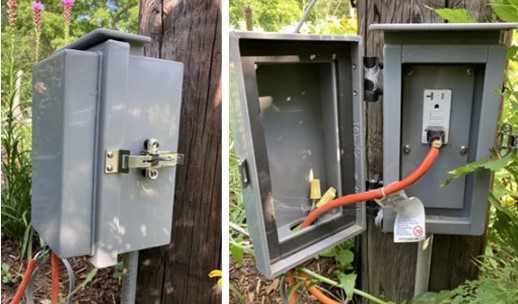
Outdoor outlets often require protective devices as part of the circuit design. Integrating the right protective elements into the enclosure plan ensures the installed outlet functions safely under expected outdoor conditions.
Aligning device selection with the enclosure prevents mismatches that can compromise safety or good to inspection issues.
Good outcomes depend on planning before ordering parts. A short pre-installation checklist helps installers avoid mismatches between box type, device and site.
Small additions to a job brief — such as labeling circuit identities and noting disposal routes for old enclosures — reduce surprises during commissioning.
| Location | Typical enclosure choice | Practical tip |
|---|---|---|
| Home exterior wall | Weather-rated, surface-mounted box | Use in-use covers near walkways and patios |
| Landscape lighting point | Small sealed box with conduit entries | Protect cable entries from pooling water |
| Garage exterior | Robust box with room for devices | Provide clear access for maintenance |
| Pool or water feature area | Heavily sealed enclosure with protected devices | Keep GFCI protection accessible but sheltered |
This table is meant as a concise reference for pairing site types with appropriate enclosure strategies.
An Outdoor Socket Box is easier to manage when inspection and maintenance are planned into property routines. Regular checks catch early signs of seal failure, corrosion or fastener loosening before they develop into electrical faults.
Routine attention extends the effective life of exterior electrical systems and reduces the risk of surprise failures.
Owners often balance convenience—such as leaving extension cords connected during an event—with code-driven safety requirements. The enclosure and device choices should enable practical use while remaining compliant with current safety practices.
This balance keeps outdoor power usable without sacrificing protection or inspection readiness.
Choosing the right Outdoor Socket Box influences not only short-term convenience but also long-term safety and serviceability. A well-considered enclosure reduces corrosion, protects devices and simplifies maintenance. For more information on outdoor socket box applications and solutions, you can visit nante.
 +86-577-62731897
 shireen@nante.com
 No.688 chezhan Road, Liushi town, Wenzhou, China
Copyright © 2024 Fly-Dragon Electrical Co., Ltd. All Rights Reserved.
 浙公网安备33038202003041号
 Privacy
Outdoor Socket Box Factory & Outdoor Electrical Distribution Panel Factory



 English
 Español
 Português
 Deutsch